

Fellowship Opportunity for Georgetown Students
Posted in Undergrad Opportunities
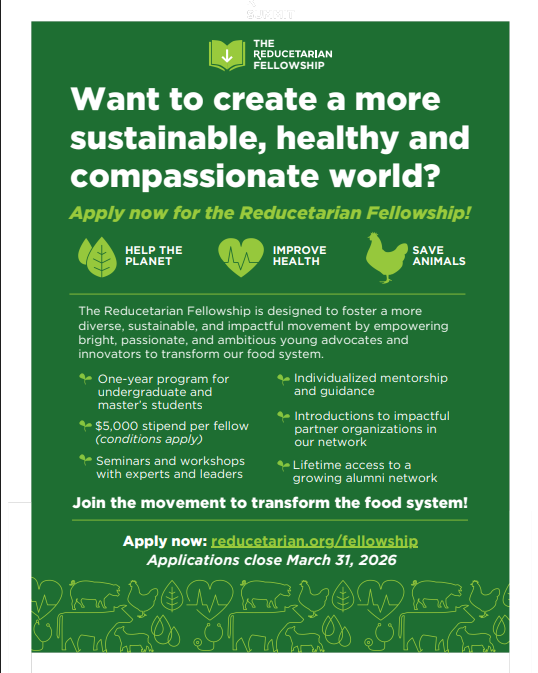
The Reducetarian Fellowship is a unique opportunity for students to begin building the knowledge, skills, and experience needed to make a tangible impact on our food system. This exciting program is designed to foster a more diverse, sustainable, and impactful movement to reform the food system by empowering bright, passionate, and ambitious young advocates and innovators who are eager to create a more sustainable, healthy, and compassionate world. Features include: 30+ in-person seminars and workshops, one-on-one mentorship from Fellowship staff, introductions to impactful
organizations in our network, and a $5,000 stipend (contingent upon internship placement at a partner organization).
Applications close March 31st!
Oerview
The Reducetarian Fellowship is open to undergraduate and master’s students in the New York City, Washington, DC, and Atlanta metro areas, and is designed to foster a more diverse, sustainable, and impactful movement by empowering bright, passionate, and ambitious young advocates and innovators to transform our food system. We encourage students from all disciplines and backgrounds to apply for this program.
Below we outline some of the ways in which students from various disciplines may connect to the Reducetarian mission and broader food systems issues we will explore throughout the fellowship. Note that this list is not exhaustive; we expect that students in a wide variety of additional courses of study would find this program interesting and valuable. Partner organizations that may be of interest as summer internship sites are also listed for each field of study.
Table of Contents
Environmental Studies and Earth Sciences
Social and Environmental Justice
Nutrition, Dietetics, and Food Studies
Public Health and Global Health
Photography, Photojournalism, and Film
Fashion Design and Materials Science
Animal Science, Animal Welfare, and Philosophy
Communications, English, and Journalism
Sociology, Anthropology, and History
Criminal justice, Pre-law, Paralegal, and Legal Studies
All Sciences (Biology, Chemistry, Biochem, Biotech, etc.)
Computer Science, Computer Programming, and CIS
Accounting, Economics, Finance, and Math
Business, Advertising, Marketing, and Management
Administration, Human Services, and other Operations-related areas
Agriculture and Horticulture
because of the need to understand and innovate on the best alternatives to industrial animal agriculture (Better Food Foundation, Farm Forward, Compassion in World Farming)
Environmental Studies and Earth Sciences
because of the impact that industrial animal agriculture has on our planet and climate: greenhouse gas emissions, land use, use of non-renewable resources, inefficiency in energy conversion, etc. (Jane Goodall Institute, Environmental Working Group, ProVeg International)
Social and Environmental Justice
because of the disproportionate impact industrial animal agriculture has on marginalized communities: food apartheid, exploitative labor, and environmental pollution. As well as the importance of building and growing a more diverse, equitable, and intersectional movement (APEX Advocacy, FarmSTAND)
Health Sciences
because of the importance in understanding how industrial animal agriculture impacts health not just through the lens of nutrition and individual health, but also from a broader scope of global health. As well as to address the lack of nutrition education in medicine
(American College of Lifestyle Medicine, Educated Choices Program, Balanced, Lighter, Better Food Foundation)
Nutrition, Dietetics, and Food Studies
because of the impact that diets that include animal products have on our bodies. As well as the need to understand our complex relationship with food and observe food production and consumption through cultural, historical, social, and ethical contexts. (American College of Lifestyle Medicine, Balanced, Lighter, Better Food Foundation)
Public Health and Global Health
because of the public health impacts of industrial animal agriculture: zoonotic disease, antimicrobial resistance, environmental pollution, and broader climate impacts (American College of Lifestyle Medicine, Educated Choices Program, Environmental Working Group)
Art and Graphic Design
because all groups working on these important issues need compelling and effective visuals in order to reach and engage the public (Faunalytics, almost all partners)
Photography, Photojournalism, and Film
because visual media is extremely powerful and is an essential piece of how our movement raises awareness about the realities of factory farming (We Animals Media)
Fashion Design and Materials Science
because the leather, wool, etc. industries have a relationship with the animal agriculture industry wherein if we can reduce use of animals for those and other materials, it will impact animal-based food producers as well (Material Innovation Initiative)
Animal Science, Animal Welfare, and Philosophy
because of the impacts industrial animal agriculture has on animal health and well-being and the importance of approaching this issue from a dimension that includes the moral consideration of animals (Compassion in World Farming, APEX Advocacy, Environment and Animal Society of Taiwan, Farm Forward, Sinergia Animal)
Psychology
because of the importance of understanding human psychology and behavior in order to better frame and grow our advocacy (Faunalytics, Compassion in World Farming)
Communications, English, and Journalism
because all groups need written content—from advocacy organizations conducting undercover investigations to think tanks putting out research summaries (Sentient Media, almost all partners)
Education
because of the need to educate the public and future generations and create a broader cultural shift of how society views and tackles the issue of industrial animal agriculture (Educated Choices Program)
Sociology, Anthropology, and History
because of the need to study other social movements and social change. As well as to understand the historical importance of food and food culture (this one could go in multiple directions—some may enjoy a internship at Compassion in World Farming because of their unique and strategic approach to corporate campaigns; others may be more interested in going to Rethink Priorities and support their research efforts)
Political Science and Policy
because policy is a powerful tool for change, and understanding how governments and government actors operate is key to making advances in this approach (ProVeg International, Good Food Institute, Food Integrity Campaign)
Criminal justice, Pre-law, Paralegal, and Legal Studies
because of the importance of leveraging various legal tactics in our movement to fight back against the lobby power of industrial animal agriculture that has historically allowed them to manipulate regulatory powers. As well as the need for public defenders for animal and environmental advocates who are subject to unconstitutional legislation like ag-gag laws (Animal Legal Defense Fund, Legal Impact for Chickens, FarmSTAND)
All Sciences (Biology, Chemistry, Biochem, Biotech, etc.)
because we need scientists and researchers of various backgrounds to continue to grow the alternative protein sector: development of plant-based, fermented and cell-cultivated alternatives to animal products (Good Food Institute, New Harvest, The EVERY Company, Material Innovation Initiative)
Computer Science, Computer Programming, and CIS
because of the need for software engineers who can help to support the organizations in our movement through website development, automation of manual processes, and streamlining data entry (almost all partners)
Accounting, Economics, Finance, and Math
because in order for innovators in this space to get their new projects, organizations and companies off the ground, we need investors who are supporting climate, health, and animal-friendly initiatives (VegFund, Joyful Ventures)
Foreign/World Languages
because of the need to translate content to reach a broader global audience and build a more diverse anti-factory farming movement that can seamlessly share the insights they have to offer. As well as to team up with global organizations and companies who have expertise in the regions they operate in (Sinergia Animal, Environment and Animal Society of Taiwan, Educated Choices Program, Sociedade Vegetariana de Brasileira)
Business, Advertising, Marketing, and Management
because of the need to further improve existing companies that develop plant-based food products, as well as expand the market of plant-based alternatives (The EVERY Company, Miyoko’s, Dr. Bronner’s, Plantega, Lighter)
Manufacturing
because plant-based, fermented, and cell-cultivated food products need to be manufactured (The EVERY Company, Miyoko’s)
Administration, Human Services, and other Operations-related areas
because of the need for strong infrastructure in the companies and nonprofit organizations working on addressing industrial animal agriculture (almost all partners)
Students generally interested in doing research, regardless of their major, could be placed at organizations like Rethink Priorities, Faunalytics, and the Breakthrough Institute, among others. Students passionate about racial justice may be interested in an internship at APEX Advocacy, students interested in worker’s rights could be placed at Food Integrity Campaign.