

Carlos Segura Santana (G’27) on how the M.S. in Financial Economics strengthens his foundation
Posted in Graduate Students | Tagged M.S. in Financial Economics
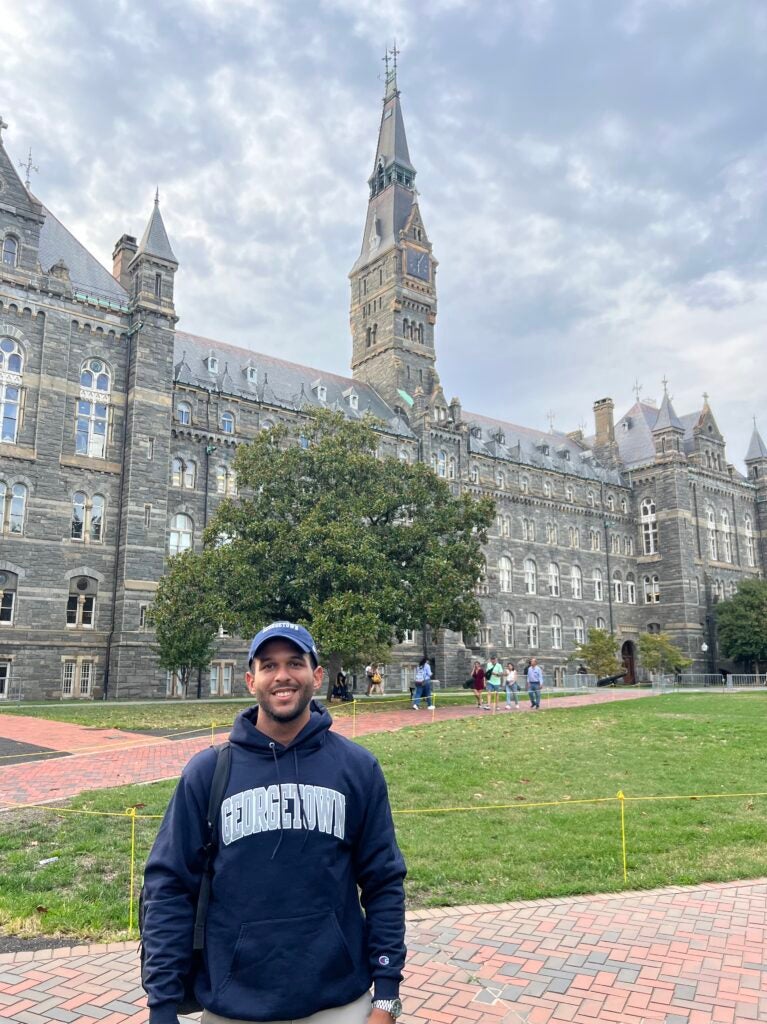
Carlos Segura Santana (G’27) brings a passion for macro-finance to Georgetown University’s M.S. in Financial Economics program, where he is eager to sharpen and expand his expertise to make a meaningful impact in debt capital markets. Holding a bachelor’s degree in economics, Carlos has gained valuable experience with leading institutions such as the International Monetary Fund (IMF), the Dominican Republic Ministry of Finance’s Public Debt Office and the Central Bank of the Dominican Republic. His work has involved everything from country-specific analysis and empirical research to sovereign bond issuance and exchange rate strategy. By combining these professional experiences with the rigorous training he’s receiving in the program, Carlos is building a solid foundation for a thriving career in global finance.

Why did you choose the M.S. in Financial Economics program at Georgetown?
I chose Georgetown because after moving to the United States for work in 2022 and starting my career, I realized my interest in economics is most centered on macro-finance, and I wanted formal training that sits exactly at that intersection. The M.S. in Financial Economics is a strong fit for that focus, and Georgetown also offered the mix I was looking for: an excellent network of professors, strong professional connections and a location in the city I’ve been calling home.

What are your career goals? How do you think this program will help you achieve them?
My career goal is to position myself as a macro-financial analyst, ideally on a debt capital markets (DCM) desk at an investment bank such as JPMorgan or Citibank. My experience in the Dominican Republic Ministry of Finance’s public debt office, working on sovereign bond issuance, inspired me to pursue the issuer process from the market side and contribute to execution and strategy in capital markets. This program supports that goal by providing rigorous technical training in financial economics and by connecting students with experienced practitioners through faculty networks and guest speakers, which helps bridge academic preparation with real-world debt capital market work.
What has been your best classroom experience so far, and why?
My best classroom experience so far was in my financial markets and institutions course, when the professor invited a director from an investment bank to speak with our class about mergers and acquisitions. The talk was especially insightful because it connected the concepts we study to how decisions are made in practice, and it gave a clear view of the skills and mindset that the industry values. It was one of the most engaging and memorable classroom sessions I have had, and it reinforced why I wanted a program that blends academic rigor with exposure to practitioners.
What advice would you give a prospective student interested in the M.S. in Financial Economics program?
I would advise prospective students to be clear that they want a finance-oriented approach to economics, because the program is strongly centered on financial economics and market-relevant applications. It helps a lot to enter with a well-defined plan for how you want to use the degree, whether that is in capital markets, policy institutions or macro-finance research. If someone is still exploring their direction, I would recommend doing a bit more research on the curriculum and speaking with current students or alumni to determine whether this program or another Georgetown master’s in economics program best matches what they are looking for.
What skills have you developed through the M.S. in Financial Economics courses? What coursework or projects helped you develop those skills?
Through the M.S. in Financial Economics, I have deepened my econometrics and programming skills by learning the methodological foundations behind tools I previously used more empirically in my work at the IMF. My coursework in econometrics and data analysis has strengthened my understanding of model assumptions, identification choices and how to interpret results rigorously. I have also improved key communication skills through team-based projects and final presentations, where we had to implement complex models and explain the findings clearly and logically. This has helped me translate technical analysis into takeaways that a broader audience can understand.
Advance your career in financial economics
The M.S. in Financial Economics program at Georgetown University is a full-time, on-campus program that prepares you to make an impact in the field.